The core objective of food preservation is to delay spoilage, retain nutrients, and extend shelf life. Currently, the mainstream solutions fall into two categories: oxygen absorber preservation and traditional preservation. The former relies on a low-oxygen environment to lock in freshness, while the latter relies on temperature control, humidity control, and sealing to preserve freshness. The two differ significantly in principle, effectiveness, and applicability, as detailed below:
I. Food Oxygen Absorber Preservation: Low-Oxygen Freshness Locking, Safe and Efficient
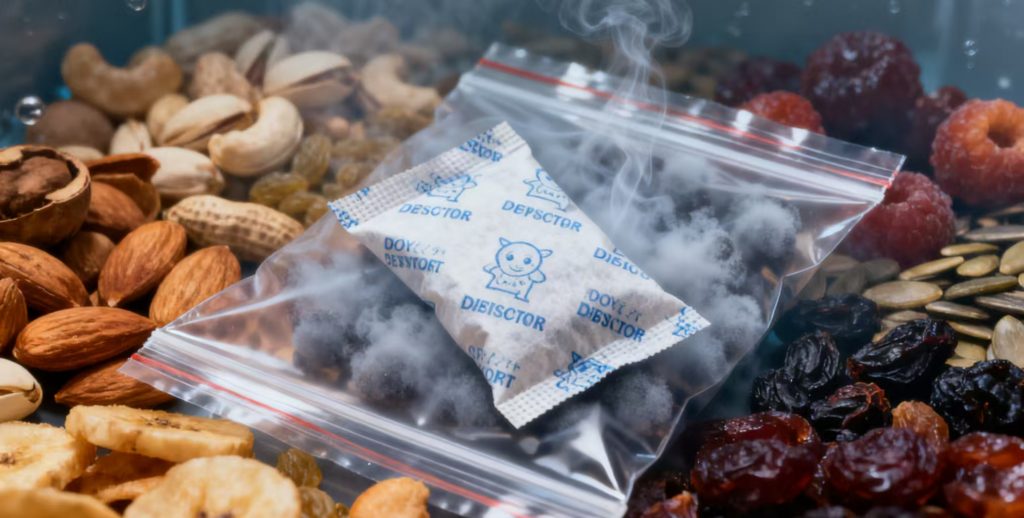
Oxygen absorbers, also known as oxygen desiccant agents, are mostly small packages containing non-toxic, inert components such as iron powder and salt. Their core function is to absorb excess oxygen in sealed containers, creating a stable low-oxygen environment. This reduces food spoilage, flavor loss, and nutrient depletion caused by oxygen at the source, without altering the food’s original state.
Its applications are wide-ranging, covering snacks, dried fruits, nuts, candies, grains, and other dried goods. It can also be used in conjunction with vacuum-packed foods, effectively preventing spoilage and maintaining quality in bulk dried goods storage. Its advantages are significant: First, it offers excellent preservation, extending food shelf life by up to three times, unaffected by external factors such as power outages or weather, demonstrating strong preservation stability. Second, it retains nutrients well, as it avoids high-temperature processing, dehydration, and salting, maximizing the preservation of the food’s original flavor, color, and nutritional components. Third, it has low operating costs, requiring no specialized equipment, only sealed packaging, and is suitable for both large and small batches of food. Fourth, it is highly safe, as the material is non-toxic and does not react with food, preventing spoilage.
However, oxygen absorbers also have limitations; they only work in sealed environments and are not suitable for exposed storage or for high-moisture, untreated foods.
II. Traditional Food Preservation Techniques: Diverse Categories, Each with Its Own Application
Traditional food preservation techniques have been used for many years, relying on logics such as temperature control, humidity control, sealing, and osmotic pressure regulation for preservation. Different technologies have significantly different applicable scenarios and advantages/disadvantages. The mainstream types are as follows:
Refrigeration Preservation: Relies on the low temperature of the refrigerator to slow bacterial growth and delay food spoilage. Suitable for most ingredients such as fruits, vegetables, meats, and cooked foods. It is simple to operate and requires no additional food processing. However, the preservation period is limited, only extending the shelf life by 1-2 times. Food will still spoil after this period, and it relies on continuous power; it is prone to failure after a power outage, and long-term use incurs electricity costs.
Freezing Preservation: Lowers the temperature of food below freezing, directly inhibiting bacterial growth. Suitable for fruits, vegetables, meats, and cooked foods, it can extend the shelf life by more than 3 times and retain nutrients to the greatest extent. The disadvantages are that it requires a large amount of refrigerator space, the texture of some foods changes after thawing, and it also relies on continuous power.
Canning Preservation: Food is placed in sealed cans, isolating it from oxygen, moisture, and contaminants, achieving long-term freshness at room temperature. Suitable for vegetables, fruits, sauces, soups, etc., with a shelf life of 1-2 years and convenient storage. However, it requires specialized canning containers and canning machines, resulting in high equipment costs, cumbersome operation procedures, and significant loss of vitamins and other nutrients during the high-temperature sterilization process.
Drying Preservation: Excess moisture is removed from food through sun-drying, air-drying, dehydration machines, or ovens, destroying the bacterial environment. Suitable for dehydration-resistant fruits, vegetables, and meats. Dried foods are lightweight and easy to store, with no or low equipment costs (sun-drying/air-drying) or low costs (dehydration machines/ovens). The disadvantages are that water-soluble nutrients are easily lost during dehydration, the food has a drier texture, some dried foods need to be rehydrated before consumption, which is time-consuming, and sun-drying/air-drying is greatly affected by weather.
Pickling Preservation: High salt content regulates the osmotic pressure of food, inhibiting bacterial growth. Suitable for meats and fish, no specialized equipment is required, and the operation is simple. However, this can lead to excessive salt content in food, resulting in a salty taste that is not suitable for everyone. Furthermore, it requires rinsing and soaking to remove salt before consumption, adding an extra step.
III. Summary of Core Differences Between the Two Preservation Technologies
Oxygen absorber preservation focuses on “low-oxygen freshness locking,” and its advantages lie in its safety, non-toxicity, low cost, simple operation, stable freshness, and good nutrient retention. It is suitable for dried goods and airtight packaged foods. Traditional preservation technologies are more diverse, covering a wider range of foods. Some technologies have no equipment costs or extremely long shelf lives, but they generally rely on electricity, equipment, or weather. Some solutions suffer from significant nutrient loss and have high consumption thresholds, requiring flexible selection based on the type of food and storage conditions.